


The implementation of medical intelligence solves the pain points of primary healthcare and promotes the use of medical AI from "being able to use" to "being used effectively"
Time: 2025-08-15 18:03:46
Click:
In the wave of digital transformation, artificial intelligence technology has penetrated the entire chain of medical services, from early screening to precision treatment, from drug development to postoperative management, providing a strong driving force for the medical industry to "improve quality and efficiency".
In the wave of digital transformation, artificial intelligence technology has penetrated the entire chain of medical services, from early screening to precision treatment, from drug research and development to postoperative management, providing strong momentum for the medical industry to "improve quality and efficiency."
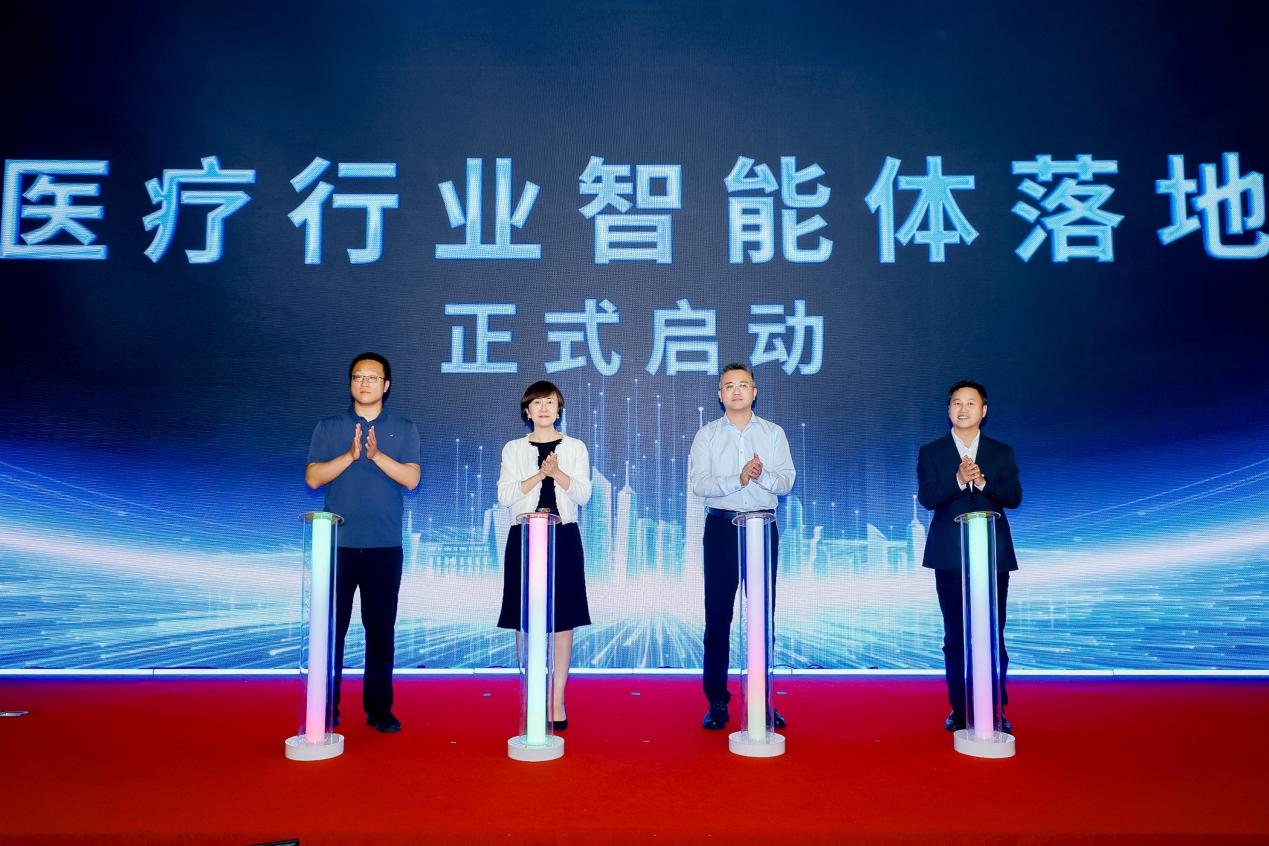
Recently, China Telecom Shanghai (hereinafter referred to as "Shanghai Telecom"), Shanghai Kupas Technology Co., Ltd. (hereinafter referred to as "Kupas"), the Xuhui District Health Commission, and China Telecom Artificial Intelligence Technology Company jointly launched the "Healthcare Industry Intelligent Body Launch Ceremony." This intelligent body leverages digital technology and artificial intelligence to create an "intelligent body + medical platform" application. By integrating large-scale model algorithms with authoritative medical knowledge, it provides family doctors with a comprehensive clinical intelligent decision-making support system for all scenarios. Through the platform, family doctors gain comprehensive clinical decision-making support capabilities, as well as daily health and scientific knowledge for patients, including health consultations, rehabilitation care, and personalized sports nutrition. Residents can enjoy "high-quality medical services right at their doorstep."
What is the core logic and application prospects of this intelligent platform? How can it solve the problem of medical data governance? And how can it empower grassroots doctors and benefit the people?
Primary healthcare once faced multiple pain points
In 2016, the family doctor system, often referred to as the "gatekeeper of health," began to be fully implemented nationwide, particularly to address healthcare needs for key populations such as those with chronic diseases and the elderly. Shanghai, as a pilot city, began implementing the family doctor contract system in 2011.
"The total number of people who have signed contracts with family doctors in Shanghai has exceeded 11 million, the contract signing rate for permanent residents has reached 45%, and the contract signing rate for key groups such as the elderly and patients with chronic diseases has exceeded 84%; 50% of the outpatient appointment numbers in Shanghai's secondary and tertiary hospitals are open to the community first, enabling quick appointments with family doctors..." On May 18, 2025, a set of data released by the Shanghai Municipal Health Commission showed the latest progress Shanghai has made in the family doctor contract signing rate.
However, family doctor contract services in my country still have a long way to go, with many difficulties, pain points, and bottlenecks. In a 2024 report in IT Times, Du Xueping, one of China's first-generation general practitioners and former president of the General Practitioners Branch of the Chinese Medical Doctor Association, admitted that each general practitioner in his institution had to sign up 500-2,000 patients. "There's not enough staff. General practitioners are not only family doctors, but also have to complete outpatient clinics, teaching and research, scientific research, social work, and other tasks. They are too busy to handle everything."
"Primary healthcare and family doctors are closely linked. Besides staffing issues, they currently face the dual challenges of insufficient capacity and trust." Zhang Wei, Deputy General Manager of the Digital Integration Department of Shanghai Telecom's Cloud Center Platform, observed the development of the family doctor system. On the one hand, primary healthcare is primarily staffed by general practitioners, but the clinical training pathways for general practitioners and specialists differ significantly. Unlike specialist medicine, which has a clear, full-process training system, this results in a relatively weak primary healthcare system for treating specialized diseases. On the other hand, some residents equate common and minor illnesses with serious illnesses, preferring treatment at tertiary hospitals and exhibiting low trust in primary healthcare.
The Outline of the "Healthy China 2030" Plan points out that we must follow the principles of reform and innovation and give full play to the leading and supporting role of scientific and technological innovation and informatization. For many years, my country's medical digitalization construction has been in continuous progress. "By now, the accumulation of clinical data is very sufficient. How can we activate this medical data and enable it to play a role in solving primary medical problems? How can we truly apply this data to the clinic and provide assistance to clinicians so that when doctors see a case, they can clearly know how to deal with it?" Zhang Wei said that China Telecom began to deploy large AI models several years ago. After going through algorithm iteration, general capability development, intelligent body architecture and platform construction, it gradually focused on vertical application scenarios in industries such as medical care, and the medical industry intelligent body platform came into being.
The "wings of AI" are spreading
The medical industry's intelligent body platform covers core grassroots medical assistance scenarios and has four core advantages: First, it comprehensively covers the entire diagnosis and treatment process, integrating clinical auxiliary functions such as physical examination report analysis, interpretation of abnormal indicators, risk assessment, health management guidance, and care for special groups to build a full-cycle health management system; second, it relies on intelligent body technology to achieve personalized decision-making, and by analyzing residents' health data, it provides family doctors with accurate disease judgment and treatment plan recommendations to improve the accuracy of diagnosis and treatment; third, it brings together authoritative knowledge such as medical general knowledge, expert consensus, and clinical guidelines to ensure that every clinical recommendation has a scientific basis; fourth, it updates data in real time and performs intelligent analysis to help family doctors quickly obtain key information.
"The implementation of the platform will effectively alleviate the shortage of medical resources at the grassroots level." The person in charge of the relevant project of Shanghai Telecom said that through functions such as intelligent summary of patients' chief complaints, analysis of abnormal test results, and intelligent triage and guidance, family doctors can handle daily diagnosis and treatment work more efficiently, and the ability of the grassroots tiered diagnosis and treatment system to undertake will be further enhanced.
"It's not just a data platform, but also a 'digital twin' of the clinician, integrating recognition (understanding), thinking, memory (connection), precise retrieval, and aggregation." Gong Wei, Product Manager of Shanghai Telecom's Artificial Intelligence Product Center, explained that the logic behind using the AI agent for family doctors is not significantly different from using existing hospital information systems. Previously, when loading patient data such as "chief complaint, current medical history, past medical history, and laboratory test data" through the information platform, primary care physicians had to draw on their clinical experience to diagnose and formulate treatment plans. After connecting to the AI agent platform, the same operation will occur. The platform will proactively collect data such as the patient's medical history, chief complaint, personal and family history, and laboratory test data. It then analyzes the data in a clinician's way and, based on medical knowledge and evidence-based medicine, provides analysis of abnormal patient indicators, clinical diagnosis and treatment recommendations, as well as suggestions for daily life and follow-up visit characteristics. This provides primary care physicians with more comprehensive decision-making advice on clinical diagnosis and treatment, thereby improving the clinical level of primary care.
Throughout the entire process, there has been no significant change in the usage scenarios and operating habits of primary care doctors, as well as in their interactions with patients. However, business thinking and processing capabilities have been added to the back-end. That is, it will be used to understand user problems, break down problems with medical thinking, accurately retrieve knowledge, and combine users' historical questions and answers with health data to aggregate and summarize professional clinical decision-making recommendations, assisting primary care doctors in diagnosing and treating diseases more comprehensively and accurately.
For the general public, health education will be a key focus during this phase. Improving residents' health literacy will help them transition from treating illness to preventing it, enhance trust in primary care for common diseases, and further promote the effective development of tiered diagnosis and treatment. Simply having access to intelligent agents isn't enough; the key is knowing how to use them.
"For young people, we may adopt a question-and-answer interactive system; for older people, we will gradually introduce them into the community, and through all-in-one robots or other auxiliary methods, with the presence of volunteers, allow the elderly to communicate and ask questions naturally through natural language and voice." Gong Wei said that at this stage, the service capabilities of health science popularization are generally used as the basis to provide residents with what diseases are, nutritional knowledge, and how to perform daily care, so that they know how to manage their health before common diseases or health risks occur.
In the near future, grassroots hospitals in some districts of Shanghai will be the first to use and experience the capabilities of this intelligent body. Subsequently, they will consider connecting wearable devices, such as common bracelets, watches, blood pressure monitors, blood glucose meters, etc., to collect data through these devices based on contract authorization, and fully track and improve the health data of contracted users, so that family doctors can provide residents with comprehensive and high-quality full-cycle health management services and enhance residents' sense of happiness in life.
Balancing rigor and scale
In the medical industry, the rigor of data is beyond doubt. In the view of industry insiders, its governance is also the biggest challenge.
Where does the data for the medical industry intelligent platform come from? Gong Wei introduced that the team has built a complete set of high-quality corpus construction standard system. The first layer is basic medical textbooks, industry standards, clinical guidelines, etc. The second layer is clinical specialty knowledge and diagnosis and treatment pathways, expert consensus, etc. The third layer is the front-end clinical innovation programs of tertiary hospitals and international research institutes. In this way, the completeness, universality and authority of knowledge are guaranteed. In terms of medical corpus, Coopers also plays a key role. By cooperating with Coopers to ensure the timeliness of the data, it allows auxiliary clinicians to use the best, latest and most effective diagnosis and treatment pathways and programs. "The basic data we cooperate with Coopers is about 14T to 15T, and this data is constantly and dynamically expanding." He said.
"In the future, corpus data will have the following trends," Kupas CEO Huang Haiqing recently publicly stated: First, corpus data will transition from internet data to high-knowledge density data; second, data will evolve from two-dimensional to multi-dimensional and high-dimensional; and third, industry verticals will become the core direction of the future. In the past, during pre-training, we believed that more data was better, but in the post-training stage, quality is more critical. In the future, we will focus more on high-quality post-training, including strong inference data, thought chain data, and the construction of evaluation datasets," said Huang Haiqing.
(Source: Shanghai Telecom)
(Editors: Mu Yifan, Xuan Zhaoqiang)
http://sh.people.com.cn/n2/2025/0520/c134768-41233805.html

暂无链接



Address:405-408, 4th Floor, Hanrun Building, No. 19 Hongzehu East Road, Suqian City, Jiangsu Province
Tel:0527-81238018
Mailbox:657782290@qq.com
Post code:223801
Scan the QR code
Follow official account

手机扫二维码
关注公众号
Copyright ©2023 All Rights Reserved 江苏领航软件科技有限公司 版权所有 粤ICP备00000000号
Copyright ©2023 All Rights Reserved xxxx有限公司 版权所有 粤ICP备00000000号
 吴医师
吴医师